Selected projects

From friction to shipped product.

Three projects built end to end: a Python reference manager automation, a shipped iOS productivity app, and a local iPad companion for supervising AI coding sessions.

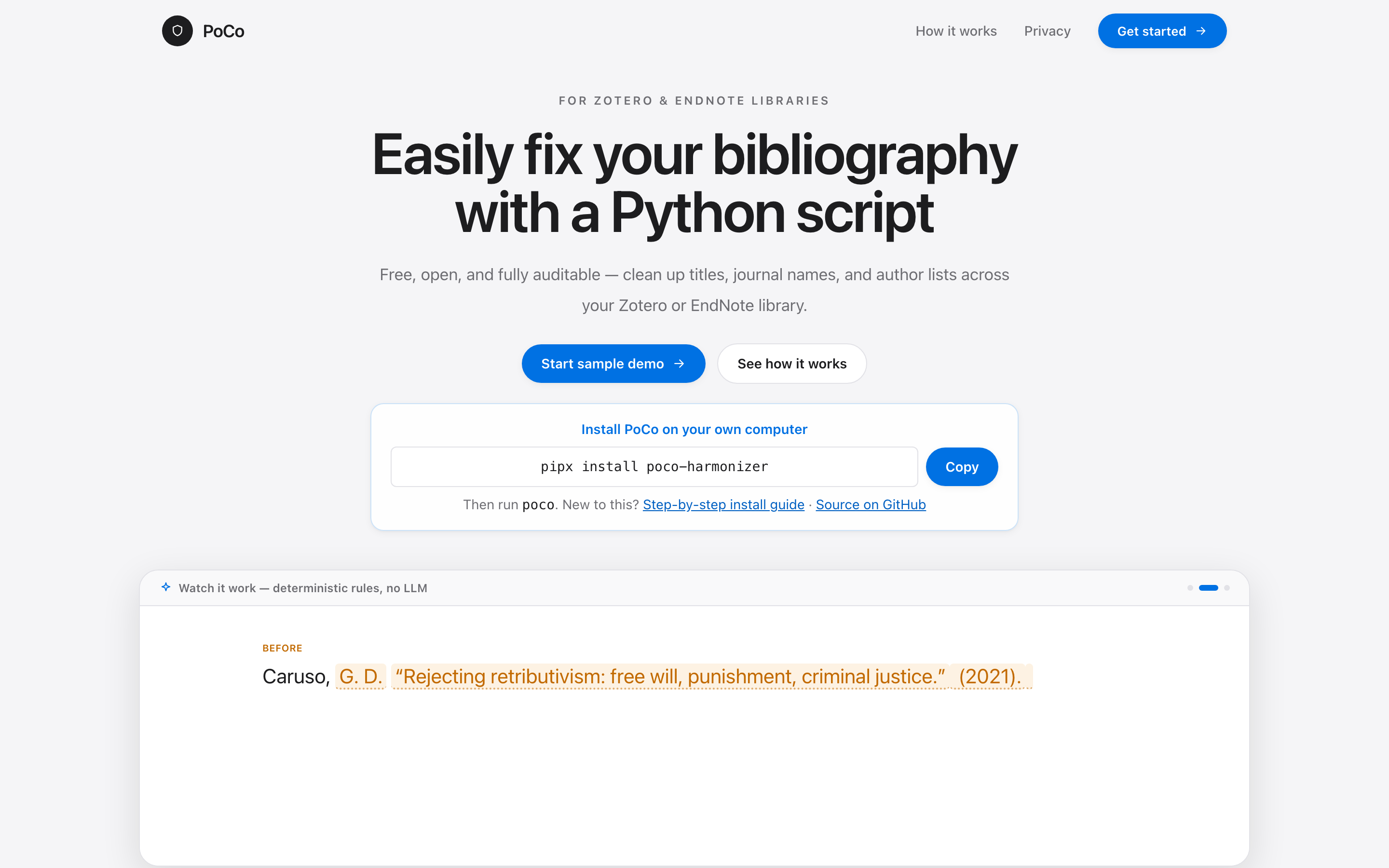
PoCo — a reference library, polished and completed. — screenshot
Live · 2026Python · FastAPI · React · CrossRef / OpenAlex

PoCo — a reference library, polished and completed.

PoCo (Polish & Complete) turns an inconsistent Zotero or EndNote export into a clean, consistent reference library without ever touching your original file. It standardises journal names, DOIs, author names, page ranges and title casing, completes missing publication metadata, and flags duplicate DOIs and retraction notices, then provides a polished copy plus a full audit trail.

The engine is deterministic by design: no LLM, no hallucination. Every proposed change is surfaced for review, where you accept, reject or edit it. I built it end to end: a Python / FastAPI engine and a React front end.

Highlights
  • Web-app — Open-source, no accounts, analytics or data gathered
  • Source-backed completion from CrossRef, OpenAlex and Open Library
  • Every change is verifiable
  • Reproducible runs + CSV / JSON / HTML audit logs
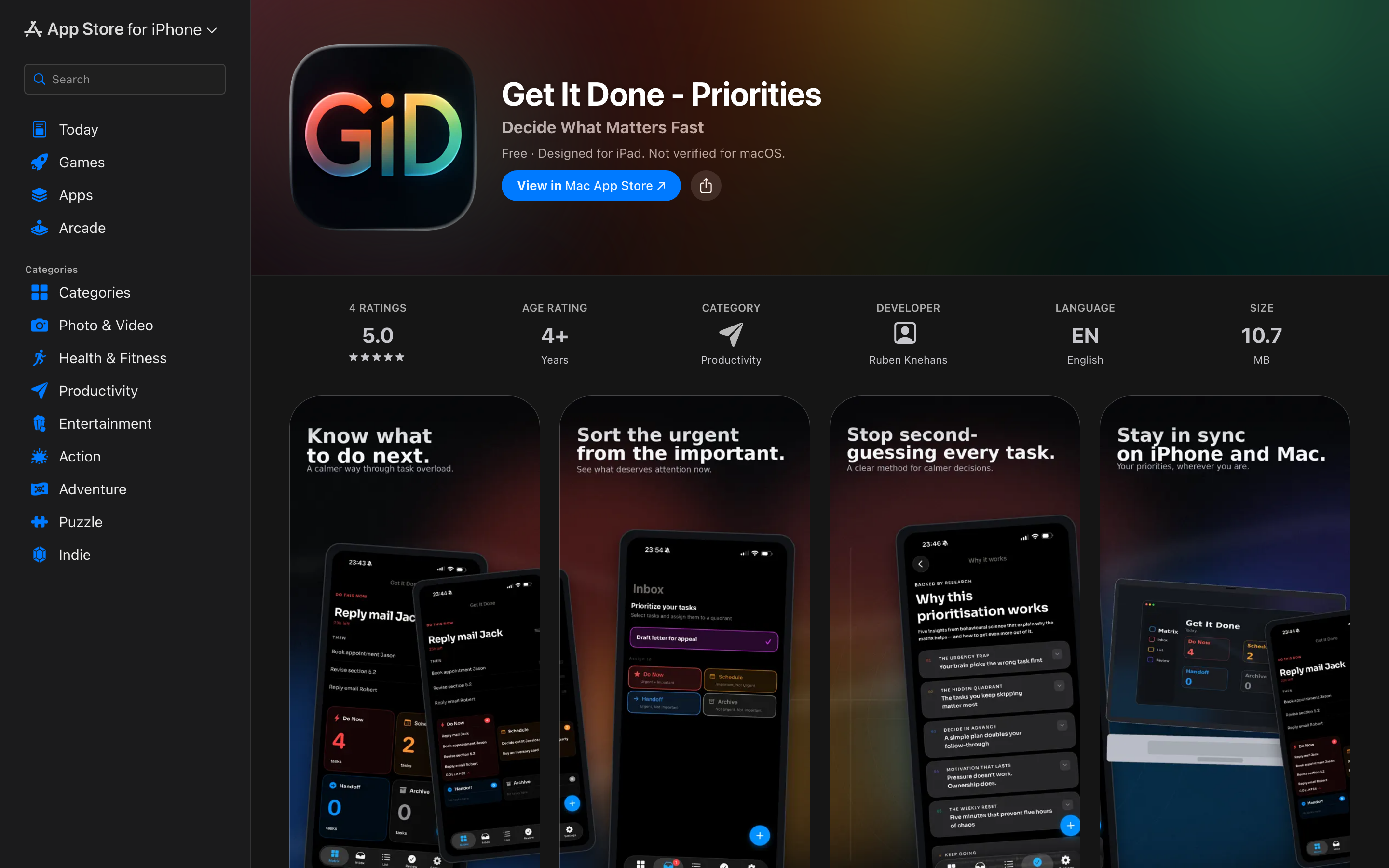
GetitDone — a productivity app, designed and shipped solo. — screenshot
Shipped · 2026iOS · Swift · Xcode · AI-assisted

GetitDone — a productivity app, designed and shipped solo.

Friction in my own academic workflow became a shipped product. GetitDone helps organise and prioritise work using an Eisenhower matrix, and I built and published it on the Apple App Store while finishing my PhD.

I ran the full product cycle: defining the problem, designing the UI and UX, iterating on user feedback, completing external review, and releasing. Four months of teaching myself AI-assisted coding, turned into something real.

Highlights
  • End-to-end product ownership, from problem to release
  • Swift & Xcode, version-controlled on GitHub
  • AI-assisted development with Claude & ChatGPT
  • Iterated UI / UX from real user feedback
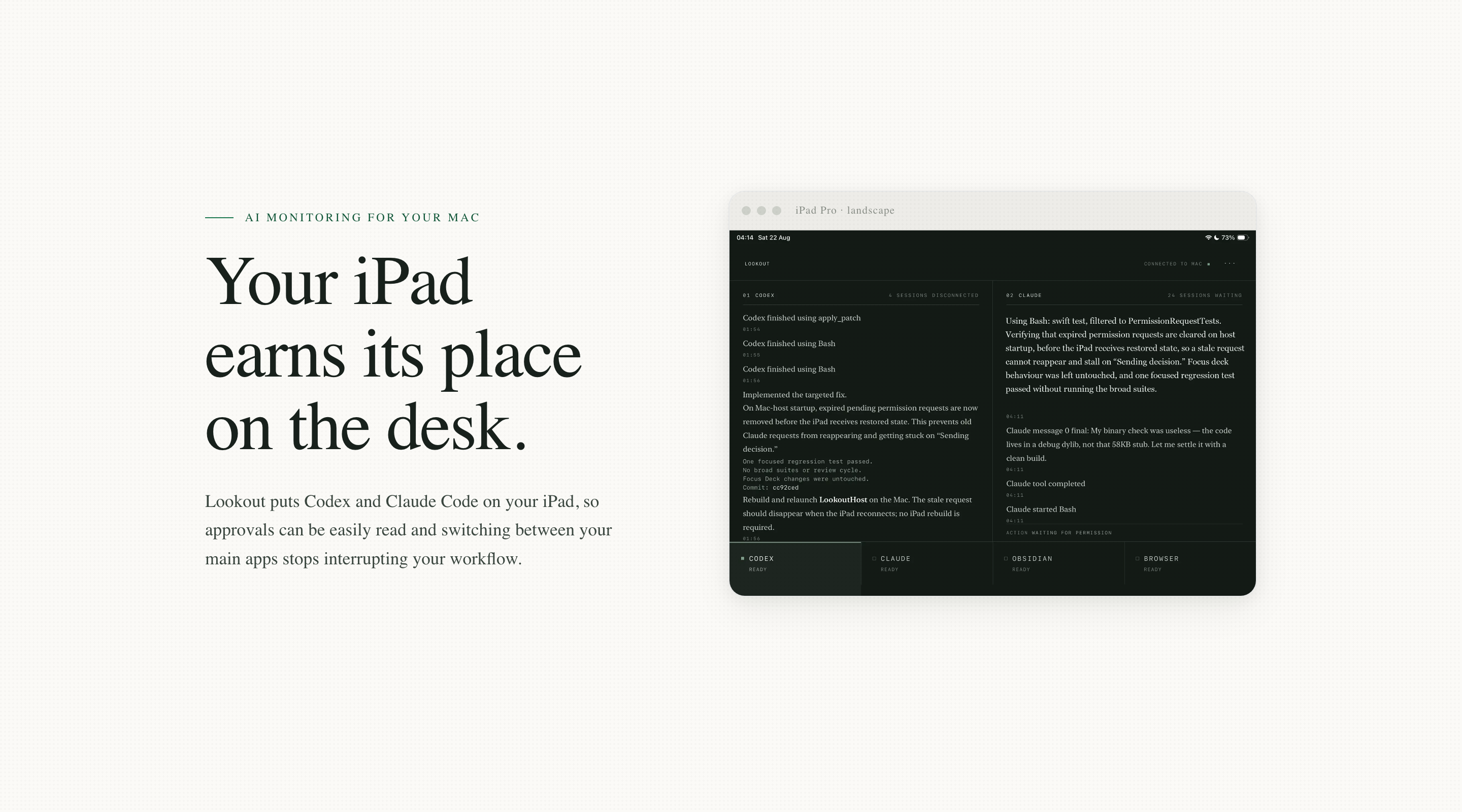
Lookout — your iPad earns its place on the desk. — screenshot
Local beta · 2026Swift · SwiftUI · macOS + iPadOS · local-first

Lookout — your iPad earns its place on the desk.

When I work with Codex and Claude Code, permission requests interrupt my focus but I want to review them myself because I do not (always) trust auto mode. Continuously switching between apps to read and give approvals got tedious. So Lookout moves those approval requests onto the iPad: Codex is on the left column, Claude on the right, each streaming what it is actually doing, with approval requests taking over the screen so I can read and approve/reject each decision.

I built it for myself, it is local-first and account-free. The Mac relays session state to the iPad over the local network, and decisions travel back through each provider's own hook, so nothing leaves the network and no third party sits in between. If the iPad is unreachable the Mac's own prompt still works, and a disconnect is never treated as an approval or a rejection. I built both sides — a macOS host and a native iPad client in Swift and SwiftUI.

Highlights
  • Native Swift / SwiftUI — a macOS host and an iPad client
  • Local network only — no account, no cloud
  • Fail-safe permissions: a disconnect never causes any action

Selected publications

Peer-reviewed & published.

2026
The Legal & Normative Regulation of Non-Invasive Brain Stimulation as a Sanction in Dutch Criminal Law
PhD dissertation — submission July 2026, Maastricht University
Dissertation
2022
Modulating Behavioural and Self-Reported Aggression with Non-Invasive Brain Stimulation: A Literature Review
Knehans, R. et al. — Brain Sciences, 12(2), 200 · Lead author
Peer-reviewed
2022
U bent niet tot antwoorden verplicht, maar… Inzichten over het zwijgrecht vanuit de rechtspraktijk
Pivaty, A. et al. — Boom Juridisch · Handbook on the right to remain silent (Art. 6 ECHR)
Co-author